Queen laying eggs

This is a neat video of a queen laying eggs on a frame. I think the fella taking the video was alone and he had to adjust his hand position so the frame of bees is lost twice, but bear with him because the video is really cool!

Watching the queen check the cells and lay eggs if she found them satisfactory was quite simply….enchanting.

Queen laying eggs

Bloom!

Tulip poplar is in bloom! That is not my hand or my picture :)

At one of the recent bee meetings, the speaker was Wayne Esaias who is the President of the Maryland State Beekeepers Association and also a scientist with NASA. He has been tracking honey bee behavior with climate change and the concurrent shift in nectar flow. Research and satellite imagery has shown that nectar flows have advanced by .58 days per year since 1970. They also found that one degree increase in temperature results in a 1 week earlier bloom.

Several interesting observations:

-Though the nectar flow starts earlier, the bloom period is the same. Plants do not extend their bloom since their bloom period is hard-wired.

-One month advance in spring nectar flows means 2 more months of high consumption rates compared to normal and this results in lower total yield.

-We should be supering our hives mid-March!

-An egg laid after March 15th has little contribution to colony yield

-Africanized Honey Bees rely on 2 nectar flows. Those states with one nectar flow do not have AFB but those states that have 2 nectar flows, do. Isn’t that interesting? So I wonder if climate warming will hasten the spread of AFB?

It was a very interesting talk, he even had satellite pictures of the “greening up” (Spring) and “browning down” (Fall) of the US.

Check out the site on NASA, it has interesting information on honey bee forage: honeybeenet and the scale hives they’re using to track the nectar flow. I found a scale hive right next to me, I wish they had real-time hive weights available then I could really know when the flow was on!

I found this site as well, even if you’re not a beekeeper you can still help: BudBurst

Nuc transfer

Sunday was Mother’s Day and a great day to become the caregiver of thousands of stinging insects. I brought the nuc over to Connie’s very early Sunday morning and we installed it without incident. We TRIED to find the queen but no luck :( I was ready to mark her… I can’t believe I couldn’t see her, I’m normally a very good “queen spotter,” not now I guess!

On my way:

Taped and strapped and ready to go.

Connie carrying her new charges, thousands of them!

Connie was super excited! Doesn’t she look happy?

They had a lovely set-up:

A very nice location for the bees.

Ready to transfer the frames.

We took a video of the installation. We were trying to spot the queen and I wanted to show Connie the eggs. Connie’s husband was the videographer, thanks Chuck!


Here it is, all set up. The nuc box was left in front of the hive to allow the stragglers to enter the hive:

The nuc was left in front of the hive to allow the remaining stragglers to enter their new home.

We stood and watched them for a while. It’s a nice location, lots of sun during the day and then shade in the mid-afternoon. I think the shade in the afternoon, especially in hot, humid Maryland is necessary. The bees were quickly active.

Connie is almost exactly 3 miles away, which should be fine for moving a hive. Most conventional wisdom states you “Move a hive 2 feet or 2 miles.” There are lots of folks that need to move their hives more than 2 feet and less than 2 miles, what are they to do? We’ll cover than another time. Once the bees were installed, we added a leafy twig to make them reorient just in case they would try to go back to their old location. When I was looking at my hives that afternoon, there were no bees at the nuc’s old location. So we should be good.

Nuc update!

Eggs in the nuc! Eggs in the NUC! You should have heard me a few minutes ago…I was yelling, “They have a queen!”

I found a lot of eggs, a few spots had 2 eggs but this in not uncommon for a new queen. This will improve with practice and workers will remove any errant eggs. The eggs were all smack in the middle, none on the sides and perfectly upright, a few even had hatched so she may have started laying around Wednesday. But I saw even younger larvae than what was ready to be capped, so she may have started  even earlier. The “insurance frames” I gave the nuc last week were a mix of capped and open brood. Not a queen cell in sight. Those eggs are now plump larvae and ready to be capped in a couple of days. YAY!!

I tried to find her majesty but just couldn’t, hopefully when we transfer the frames we’ll spot her with more eyes looking for her and I can get her marked.

Nuc update

I checked the nuc on Saturday and did not see the queen, did not see any eggs. I wasn’t too worried as the hive wouldn’t be considered queenless until next weekend (if eggs were still absent). I’m guessing with this bizarre cold/rainy/sunny weather, the queen may have needed extra days to be well-mated. All of the queen cells I noticed previously have been torn down. There were a good number of bees as I mentioned before.

Just to make sure things stay on the positive side, I gave the nuc 2 frames of mixed brood (including eggs) so if they are queenless they’ll have the resources to make another one.

I’ll check the nuc this weekend for eggs, or newly hatched larvae (tiny C-shapes). The egg hatches in 3 days, falls over and forms a C-shape, so if I see either eggs or new larvae, I’ll know there’s a queen-in-residence. If I DON’T see any queen cells built out then the bees consider themselves queenright and we just need to be patient. I just hope I didn’t transfer my queen over to the nuc! I haven’t seen my queens for a while now, though I know they’re there. I may have new spring queens and have no idea, there are so many bees that you can’t spot the queens!

Hive Inspection 4/17 and 4/29

Since I didn’t have time to post about the 4/17 hive inspection, I’m going to post it with the 4/29 to compare what we saw.

In the past week I put together 2 mediums the foundationless frames. These will be the last boxes I add to the hives. From now on, I’ll just cut off the comb they’ve built out and place that frame back in the hive for them to build out again. The comb I cut out will be of honey of course! I don’t really want to use an extractor, I plan to just do crush and strain. Still messy but simpler I think.

Tuesday the 17th and Sunday the 29th were gorgeous days for a hive inspection.

Melissa:

4/17/2012

Top medium- eggs/larvae in 6 frames, 3 frames of honey/pollen. Moved over one spot the outside frame they were just building. 7 frames of bees in the medium super.

Next medium: All of the older frames that were filled with honey have been emptied and filled with eggs. Drones along the edges. 9 frames of open brood, one of honey.

Top Deep: 1/2 frames being worked, not much in there as of yet (was added 2 hive inspections ago). Interesting that the queen is going through that deep to the mediums to lay.

Bottom deep: moved in a few frames from the edges to the middle to make them build those frames out. Not much brood down here.  Added 1/2 pollen patty (the old one cut in half).

4/29/2012

Top medium: 9 frames built out, 5 1/2 frames of brood, moved frames of honey from the old top medium into the new medium that I added this day to encourage them to move into the new box.

Next medium: 10 frames built out, brood on 8 frames, 2 honey/pollen.

Top deep: middle 2 frames starting to be built out, eggs on top portion of these. Lots of bees over the frames. Honey and pollen on the end frames (wax foundation). One deep frame full of eggs and larvae.

Bottom deep: completely empty, cappings ripped off, clearly robbed out. No bees in the bottom.

What changed from the prior inspection? Bottom deep completely empty, top deep with a little brood, 2 mediums of brood. Do you understand what this equals? I have the equivalent one deep of bees since the general rule is to use two mediums to replace one deep. Thank you Mr. Skunk.

We moved out all of the unworked frames from the deeps, condensed into one deep with mostly drawn frames but I took out the old brood frames from Peter’s hive. Husband dropped a frame…very unhappy bees, the uptick in the buzzing was so loud. I hate the sound of crunching bees as you set the hive bodies on top of each other.

Demeter:

4/17/2012

The topmost hive body is the shallow super with plastic foundation. They started working on the bottom portion of a few frames in the shallow.

Top medium: 7 frames of brood, all open brood. Remainder honey, all frames worked.

Top deep: 4 frames of brood, remainder honey/pollen

Bottom deep: honey/pollen, starting to work end frames, 4 frames eggs

4/29/12:

Working on top shallow super, some frames being worked but they really don’t seem to like the plastic at all.

Top medium: frame of capped honey on foundationless frame, 8 frames of brood, moved 2 honey frames into new medium and added empty frames. Hubby sneaked a taste of honey comb that was stuck to the wall. This hive inspection was fraught with head-pinging and angry bees. The bees were NOT HAPPY!!!!!!!!!!!!

Top deep: brood and honey, frames were wall to wall brood (at least 5). You can hear the bees hitting my veil, shirt and jeans.

Bottom deep: At this point the bees were so loud that I could barely hear myself on the voice memo until I scream because I got stung under my arm. Then hubby gets stung at his achilles. Granted we inadvertently squished bees in those areas causing the stings. Lots of honey, brood and pollen. Very large hive.

Overall Demeter is doing fine despite the repeated the skunk attacks. Melissa, not so much. I’m going to take care of this thing pronto.

You won’t believe it

So how many things can go wrong or be just plain bizarre in one week? After posting about my trip to Jim’s and getting the screens, we did a hive inspection. Remember I suspected Melissa was being robbed? Want to know what we found??? The entire bottom deep on Melissa empty. EMPTY. No brood, no stores, the cappings very obviously torn off and the bees had essentially abandoned the bottom deep. Incredible. So they were being robbed. I don’t think it’s happening any more, I believe closing them up for a couple of days did the trick. However, they did expand upstairs. Mightily. There seemed to be brood everywhere.

Initially my plan was to leave the screens in place for both hives just in case it was another colony that was attacking both of my hives. After the inspection it was pretty clear that Demeter was fine. Plus the traffic and backup was incredible on Demeter! So I took the screen off completely but left it on Melissa with the robbing entrance open. I checked on them Monday (it was cool and rainy initially changing to sunny by the PM), it looked okay just a mild pile-up as they figured things out:

I checked on them Tuesday….Oh MY LORD. It was a sunny day and the drones were out. Apparently they are so helpless that they can’t find their way back in. Check it out.

This is after I took off the screen, within a couple of minutes, the drones went into the hive:

So yesterday I took the screens off completely, and thanks to the challenged drones, I’ve decided to put on the entrance reducers again. Goodness, I feel like I have to change my strategy every day. Oh wait, I DO have to change my strategy every day.

Just to try to keep things even-Steven, I’m debating equalizing the hives: taking some stores and brood out of Demeter and giving it to Melissa. Essentially knock Demeter down a notch. I’m still thinking.

And he’s at it AGAIN!

I left the motion-activated sprinkler off last night to see if it was having any effect on the stinky rascal trying to decimate my hives. Take a look at what I found this morning:

Spit balls of bees, again. See those dark lumps between the wooden slats? There were at least 4 of them in front of Melissa.

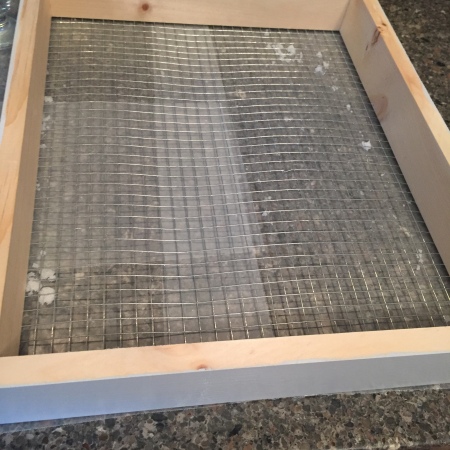
During last week’s rain I noticed a lot of dead bees on the landing and wondered if the hives were being robbed. I went to Jim’s place on Tuesday to pick up two moving/robbing screens, I showed him the pictures and he said it looked normal to him. He said that there always seems to be a lot of dead bees on the landing when it’s raining. I decided to try the screens anyway, figuring I had nothing to lose. Once I got them painted and set them on the hives I realized they needed to be reinforced somehow. They’re fine if you don’t have anything harassing your hives but with that skunk around I didn’t want it pulling off the screens. In the midst of adjusting to the new screen, it hit me…I could leave the front entrance doors open and just close them at night to keep the bees from interacting with the skunk! I have to go out there every morning to turn off the motion-sensor on the sprinkler and turn off the faucet to the hose. Every night I turn them back on. With the screen all I have to do is flip the doors open and closed!! No more sprinkler! I was very excited. To put my plan to the test, I left the sprinkler off and you know what happened. I’ve done it before out of shear forgetfulness but with no pile of bee balls. Clearly the skunk doesn’t come every night.

So this morning I attached one screen:

One screen with the latches I used, they're 1" hooks and eyes.

Predrilling the hole.

The hook on the screen, the eye will be mounted on the hive body.

Ready for install: the screens, the drill, a rag to clean the landing and hive bodies (it rained last night) and the eyes.

It's pretty secure. I pushed it in various directions to make sure it would stay put.

I put some pine branches over the entrance to make them reorient on their way out. The little metal flaps on the bottom are what I will use to close the entrance tonight. I hope this works!

So there you have it folks. As always, click on the picture to make it bigger. Wish me luck! And by the way, the nuc seems to have escaped the skunk’s attention. I’ll be checking for a laying queen toward the end of the week. May 5th marks 28 days since the nuc was made and the average time for a new queen to have emerged, mated and started laying. If all looks well then Connie can have it anytime afterwards. I remember making my nuc last year and how much I desperately I wanted to get my hands on it, just to HAVE my bees already!

What do I look for during a hive inspection?

Let me start by saying that there are an infinite number of ways to perform an inspection: there are as many ways as there are beekeepers. That said, I will tell you what I do. Each beekeeper will find their own method and will figure out what works for him or her. Personally, I need to keep notes for each inspection.

You are generally looking for the following: number of frames of brood, presence of eggs (this indicates the presence of a queen and thus your colony is “queen-right”), capped brood (see the banner at the top of the page), frames of honey, pollen, the overall number of bees and how “packed” it feels. You also want to pay special attention to the number of unworked frames, this indicates how much space they have to expand.

Reading about bees you will inevitably realize that disease and pests are another thing to monitor. Looking for mites is hard when you’re in the middle of an inspection. You can certainly see their effects if you see deformed wing virus on the workers. You’ll also note any hive beetles, try to squish them before they fly away! I crush cells in my eagerness to kill those things since the bees will repair any damage.

If you’ve been following along you will have noticed that I include certain bullet points in my summaries, namely: how many boxes (the hive-set-up) make up each hive, how many frames are being worked per hive body, the number of frames covered by bees, if I spotted the queen, # of frames of brood (good to denote if you’ve seen capped or open brood). I may throw in the number of frames of honey/sugar syrup as well.

I include an “Overall Impression” really for my own benefit to keep everything in perspective. Sometimes I think a hive is doing well only to find that it’s pretty much the same as last time.

As I write my update for the blog I review the information and can get a sense of whether I should have done something differently and what I need to change next time. This part falls under the “Plan” portion of my summary. There always seems to be something I overlooked or just didn’t do. For example, when we made the nuc, I later decided to add a 1/2 pollen patty to each hive under the ventilated cover. These patties were left over from last year and I wanted to use them up. After checking on the patties over the next few days, I realized I should have added them over the brood nests but at the time didn’t want to disturb them twice on the same day. Always add pollen patties either right above the brood nest or between if you have 2 brood boxes. Live and learn.

This is why I keep a blog, otherwise I would never remember what I did with the hives or when. There are online programs available for beekeepers as well (such as Hive Tracks and Beetight, there are others), I haven’t used them but some are compatible with iPhones or Blackberrys which is handy dandy.

References

I’ve had this post geared up for a while now. With the new beekeepers coming out of their classes, this may be a good time for it. 

When I take on a project, I read. A lot. I will read everything I can to figure out the basics before starting. I am not the type to figure it out as I go.

When you are looking for information, there are so many places to find it! There are books, websites, blogs, forums, associations and they all offer a slightly different perspective on the topic. Normally, when you’re pursuing a new topic, there are people you can talk to but beekeeping isn’t like having a dog, it’s kind of specialized. So when I realized I was going to be a beekeeper I knew I needed to start reading.

The first place I started was on Amazon by looking at the beekeeping books and their reviews. The reviews were enlightening: I had NO IDEA that beekeepers used medicines! And fed the bees sugar syrup! And high fructose corn syrup! Who knew??? 

I read the comments for the poorly reviewed books to see why people didn’t like them. Since these were reviews by beginning beekeepers and experienced ones, their comments were very interesting. It gives you an idea of what people look for in a beekeeping book.

Then of course I read the reviews for the well-rated books. And I checked those out of the library. Once I found some books I liked, I bought them.

Here are a few I read and liked enough to buy: Beekeeping for Dummies, Storey’s Guide to Keeping Honey Bees and the Complete Idiot’s Guide to Beekeeping. My favorite are the first two for their step-by-step explanations.

I like the Storey’s series because the writers are generally recognized as experts in their field and have a great deal of practical experience. If you do any beekeeping reading you’ll come across the name Richard E. Bonney. He wrote Beekeeping: A Practical Guide and Hive Management, books that are referenced by pretty much everyone it seems. He has passed away and his books have been edited and reissued in Storey’s Guide to Keeping Honey Bees. I really enjoyed reading this book and I use it for reference.

The Beekeeping for Dummies book is a perfect start to finish book, it explains EVERYTHING. I look at this book repeatedly to help me understand the bees. What I don’t use it for is hive management. It does not advocate a treatment-free approach. 

The Complete Idiot’s Guide to Beekeeping is a guide to treatment-free beekeeping but it is not a beginner’s book. It was the first beekeeping book I started to read and I found it very difficult to understand as it was not written with the beginner in mind. The information wasn’t presented in an organized way for me to understand how to keep bees. Now I  understand it, but I just didn’t get it at first.

Another book I can recommend, without actually reading it is The Practical Beekeeper by Michael Bush. He has a great website and many posts on the Beesource forums. He says his book is a compilation of his website and myriad posts on beesource and beemaster. If that’s the case (and the reviews bear this out) this is definitely one I would recommend. Based on his posts on beesource, he explains things very well and is very practical in his approach.

Websites that I’ve used for reference have included other blogs. I like it when people post their mistakes and foibles, those are what you learn from the most I believe.

Beesource forum posts are also a good read as long as you understand that everyone has a different approach. There are both “know-it-alls” and very reasonable, practical people who will post answers. Lurking taught me who to listen to. I want people who will give logical answers and explain why they suggest this particular approach. Please understand that there are often many answers to a problem or situation. Knowing a few of the answers will give you more options and help you make the better choice when you are in the field and “in the thick of it.” When you are in the middle of a hive inspection, the bees don’t give you time to go look something up. You’ll have to do your best and address the problem another day.

Join your local beekeepers club and sign up with a mentor. I didn’t have one and that was part of why I read everything I could. Your local club will have someone who will be able to help you, give you advice and act as another pair of eyes during a problem, two heads are better than one! When my husband and I do the hive inspections, I’m doing a running commentary to help me understand what is going on and if I’m seeing what I should be seeing. And if I’m not, why not? It definitely helps to have another brain with you. 

A couple of pieces of advice:

  • Read everything :)
  • Listen to other approaches and file them away, you never know when you’ll need them.
  • Never assume you know what’s going on